Hunter Fitzsimon
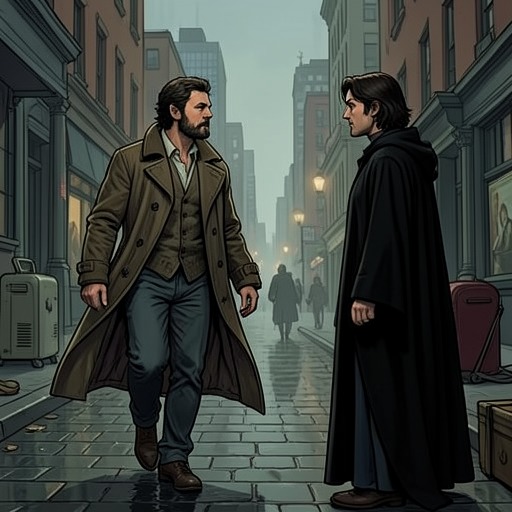
Bound by DarknessHunter Fitzsimon is a Paladin and a trusted friend of Larem q’Jones whose importance lies in the contrast he creates within Seattle’s increasingly hostile political and social climate. He has personal reasons to resent what comes through the Barrier, yet he insists that Larem is different. That distinction is not presented as naïve tolerance: Hunter has fought beside Larem, knows his character through danger and training, and is prepared to protect him when institutional policy threatens to turn suspicion into expulsion.
Identity and Position
Hunter belongs to the Paladin organization, the force responsible for much of the fighting against the Others and for the defense of Seattle. His status gives him a voice in the organization’s internal disputes, but his allegiance is not simply to its hierarchy. When a new policy creates pressure around Larem’s presence, Hunter openly condemns it and argues that Larem must not be treated as an enemy merely because he is Kalith.
His position is especially significant because the wider organization is already fractured. Sasha Willis discovers that supplies crucial to the Paladins have been delayed or denied while less important materials were stockpiled, and that jealousy and competition have been encouraged among the various factions. Against this background of administrative failure, Hunter’s loyalty operates as a practical moral judgment: he evaluates Larem through conduct and shared experience, not through the labels imposed by the Regents or by frightened guards.
Friendship with Larem q’Jones
Hunter’s relationship with Larem is grounded in mutual trust and physical familiarity. In the gym, the two warriors face one another with matching wolfish grins, salute, and begin a practice battle. Their exchange is competitive but affectionate; combat is not a test of whether Larem belongs, but one of the ordinary forms through which the friendship expresses itself.
That bond has a deeper history. Larem was condemned to execution in Kalithia after Lusahn q’Arc’s relationship with Cullen Finley created the circumstances that marked both Lusahn and Larem as traitors. During the rescue attempt led by Cullen and Barak q’Young, Lonzo Jones was badly injured while the group fought its way back across the Barrier, and Larem saved his life. Lonzo later gave Larem a home and the use of his family name on forged paperwork. Hunter’s friendship with Larem belongs to the same broader network of relationships in which Kalith and human lives become materially and emotionally interdependent rather than remaining separated by official doctrine.
Hunter also treats Larem as a fellow warrior whose abilities deserve continued refinement. After Hunter falls for Larem’s maneuver for the third time, Larem switches his sword to his left hand and offers him instruction rather than ridicule. Hunter acknowledges that he hopes one day to win, while thanking Larem for not humiliating him completely. Their handshake and Hunter’s clap on Larem’s shoulder turn the defeat into camaraderie: skill creates equality, and correction becomes an act of friendship.
Protection and Conflict
When Devlin Bane warns that the new representative of the Regents may not accept the case being made for Larem, Hunter immediately offers a concrete refuge. He tells Larem to pack his belongings and promises that the apartment over the garage is his for as long as needed, with Tate Justice also included in the offer. Devlin concedes that Hunter is right and admits that he cannot guarantee the administrator will listen. Hunter’s proposal therefore does more than express sympathy; it gives Larem a place to survive if Seattle’s official protection collapses.
Larem is tempted to leave with Hunter but refuses to hide. As a warrior by both training and nature, he will not run. Hunter’s offer remains important precisely because Larem declines it: the friendship does not replace Larem’s agency or reduce him to someone awaiting rescue. Hunter provides a choice, while Larem decides that remaining visible is preferable to abandoning the ground on which his legitimacy is being contested.
The threat is not abstract. During the new administrator’s meeting, she announces that she will study the files of everyone stationed in Seattle, beginning with the Paladins and later examining guards, support personnel, and the special guests living and working there. Larem hears the statement as a possible threat to the local Kalith population. Hunter’s defense thus stands against a system in which surveillance, records, and administrative authority can convert a person’s identity into grounds for removal.
Resistance to Anti-Kalith Prejudice
Hunter’s loyalty gains force because other voices describe the Kalith as contagious, dangerous, or inherently violent. Rumors circulate that the Paladins are “hanging out with the enemy,” while guards question why Kalith people are allowed to walk through headquarters. Duke fears that the Kalith instructors may be gathering intelligence about firearms and stun guns, and wonders whether Barak and Larem were sent across the Barrier for that purpose. These suspicions recast ordinary employment and military cooperation as evidence of infiltration.
The hostility becomes more explicit when George expresses regret that a guard failed to kill one of Seattle’s Kalith residents, calling the injured man a waste of resources. Hunter’s conduct supplies the opposing image. He does not treat Larem as a pet, a specimen, or a temporary security risk; he treats him as a friend and fellow combatant whose survival matters. Devlin Bane’s defense of Larem makes the same distinction, but Hunter’s offer of a home gives it an intimate and material form.
The narrative repeatedly sets this solidarity against the institutions that manufacture group boundaries. Paladins, guards, Kalith people, Others, and Regents are treated by hostile speakers as internally uniform categories, while actual relationships cross those divisions. Devlin trusts Larem, Lonzo has become his roommate and friend, and human characters such as Lacey Sebastian and Cullen Finley are involved in close relationships with Kalith people. Hunter’s role is to make that cross-boundary loyalty visible from within the Paladin ranks.
Narrative Role and Significance
Hunter functions as an ally and as a counterexample to the claim that fear of the Kalith is the natural response of an experienced defender. He has “more reason than most” to hate what comes across the Barrier, yet his knowledge of Larem interrupts the easy conversion of collective danger into individual condemnation. The character therefore embodies a plot principle that the book develops through friendship, rescue, romance, and combat: identities imposed from above are weaker than obligations tested in lived encounters.
His importance also lies in what he does not demand. Hunter does not ask Larem to prove that all Kalith people are harmless, nor does he make acceptance conditional on assimilation. He recognizes Larem as a trained warrior, invites him into a shared household, and meets him on the practice floor as an equal. In a story where official files, rumors, and frightened language repeatedly threaten to reduce Kalith people to a security problem, Hunter preserves the possibility of a different order—one based on remembered courage, reciprocal protection, and the stubborn refusal to let bureaucracy decide whom loyalty may include.